Every cell in your body is engaged in a continuous cycle of maintenance and renewal. One of the most important mechanisms in this process — autophagy — was poorly understood until recently. Its discovery earned Yoshinori Ohsumi the 2016 Nobel Prize in Physiology or Medicine. The nutrition question is whether eating windows are long enough to switch cells into that repair mode.
What Is Autophagy?
Autophagy (from Greek: auto = self, phagein = to eat) is the process by which cells break down and recycle their own damaged or surplus components. When functioning normally, it:
- Degrades misfolded proteins before they aggregate
- Removes dysfunctional mitochondria (mitophagy)
- Eliminates intracellular pathogens
- Provides amino acids for biosynthesis during nutrient scarcity
The rate of autophagy is tightly regulated by nutrient status. When amino acids are abundant, a protein complex called mTORC1 (mechanistic target of rapamycin complex 1) is active — and mTORC1 suppresses autophagy. When amino acids fall during fasting, mTORC1 activity drops and autophagy is upregulated.
The Fed/Fasted Molecular Switch
| State | Signalling | Effect on autophagy |
|---|---|---|
| Fed (amino acids abundant) | mTORC1 active → ULK1 suppressed | Autophagy suppressed |
| Fasted (amino acids fall) | mTORC1 inactive → AMPK active → ULK1 activated | Autophagy induced |
Any eating pattern that introduces a sustained fasting window — whether 16:8 time-restricted eating, 5:2, or extended fasting — has the potential to activate autophagy through mTOR suppression during the fasting period.
Human Evidence: The 16:8 Trial
In 2016, Moro et al. published a randomised crossover trial in the Journal of Translational Medicine. The study enrolled 34 resistance-trained men and assigned them to either:
- 16:8 time-restricted feeding: all calories consumed within an 8-hour window (1 p.m.–8 p.m.)
- Normal diet: same calorie intake spread across the full day
After 8 weeks, the time-restricted group showed significant changes compared to controls:
| Outcome | Time-restricted group | Control group |
|---|---|---|
| Fat mass | −16.4% | No significant change |
| Fasting insulin | −24% | No significant change |
| IGF-1 | ↓ 8% | No significant change |
| Inflammatory markers (TNF-α, IL-6, IL-1β) | Significantly reduced | No significant change |
Primary citation: Moro T, Tinsley G, Bianco A, et al. (2016). Effects of eight weeks of time-restricted feeding (16/8) on basal metabolism, maximal strength, body composition, inflammation, and cardiovascular risk factors in resistance-trained males. Journal of Translational Medicine, 14:290.
DOI: 10.1186/s12967-016-1044-0
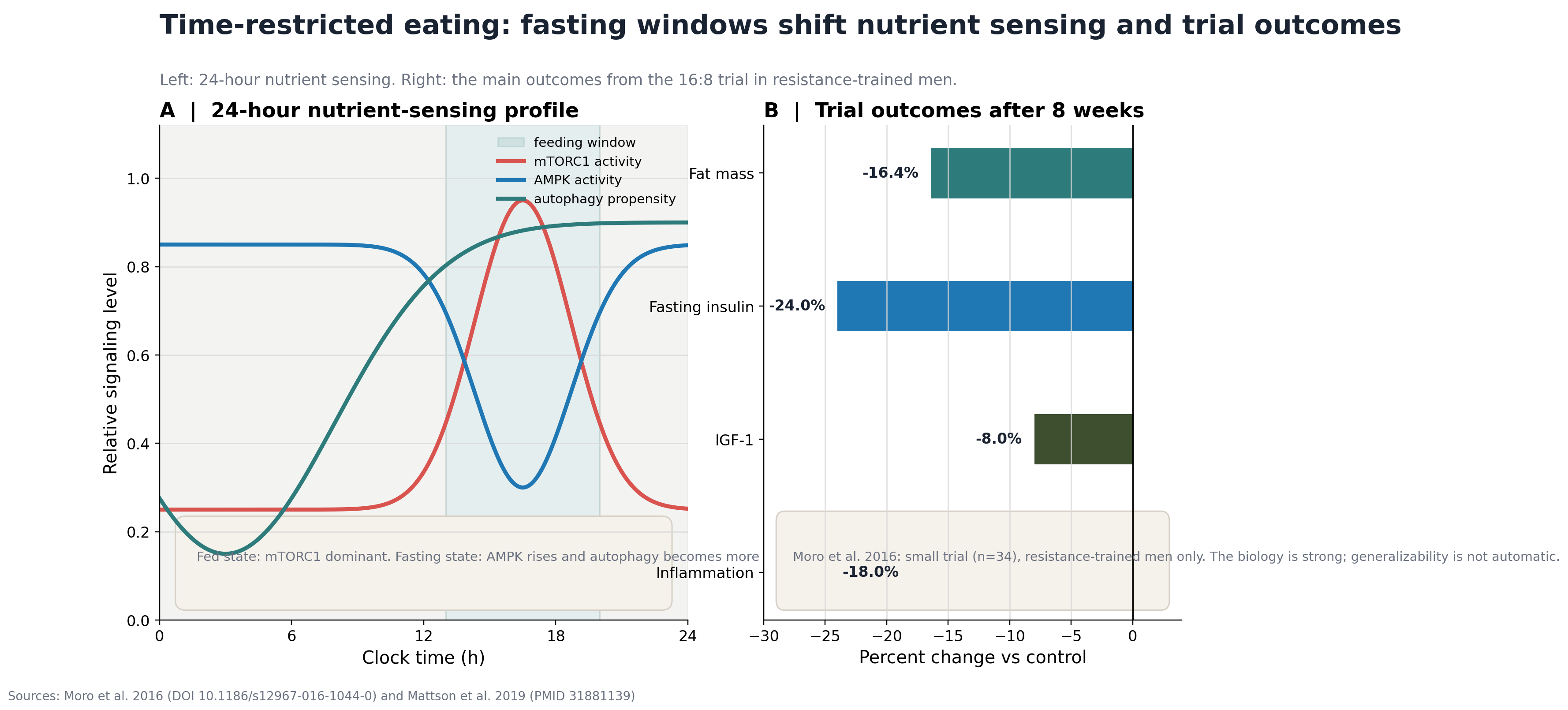
Time-restricted eating does not merely reduce calories; it changes when nutrient-sensing pathways are active. During the fasting window, mTORC1 falls, AMPK rises, and the cell can move toward autophagy.
Left: 24-hour signaling profile. Right: 8-week outcome changes in Moro et al. 2016.
This was a small trial (n=34) in young, resistance-trained males. The fat loss and metabolic improvements observed in this specific population may not generalise to sedentary individuals, women, older adults, or those with different baseline metabolic health.
The Broader Evidence: Mattson 2019 NEJM Review
A landmark 2019 review in the New England Journal of Medicine by Mattson et al. summarised the evidence across 75 years of animal research and a growing body of human trials:
- Intermittent fasting (16:8, 5:2, alternate-day) consistently produces metabolic switching — the shift from glucose to ketone utilisation during the fasting window
- In human trials, IF produced weight loss comparable to continuous caloric restriction, with potentially greater improvements in insulin sensitivity
- Animal studies show IF extends lifespan and delays onset of multiple age-related diseases; human lifespan evidence is absent but plausible given mechanistic parallels
- Autophagy activation during fasting is biologically established; direct measurement in human tissues remains technically challenging in clinical settings
Supporting citation: Mattson MP, Longo VD, Harvie M. (2019). Impact of intermittent fasting on health and disease processes. New England Journal of Medicine, 381:2541–2551.
PMID: 31881139
Who Should Approach This With Caution
Time-restricted eating is not appropriate for everyone. It requires particular caution or is contraindicated in: pregnant or breastfeeding women; children and adolescents; people with a history of disordered eating; individuals with type 1 diabetes or taking insulin or sulfonylureas (hypoglycaemia risk); and those with low body weight or clinical undernutrition. Consult a healthcare provider before making significant changes to eating patterns if you have a medical condition or take medication.
No time-restricted eating protocol is approved to treat or prevent any disease. The primary trial cited (Moro 2016) was conducted in young resistance-trained males; generalisation to other populations requires additional evidence. Autophagy activation in humans during standard eating-window interventions has not been directly measured in most trials. This content is for scientific information only and does not constitute medical advice.
Need a research report on intermittent fasting, time-restricted eating, or metabolic switching for a specific audience or content project?
Request a Report