Of all dietary patterns studied in large-scale clinical research, the Mediterranean diet has the most robust evidence base for cardiovascular benefit. This is not primarily because it is ancient — it is because it was tested in one of the largest and most rigorous dietary intervention trials ever conducted.
The PREDIMED Trial
PREDIMED (Prevención con Dieta Mediterránea) enrolled 7,447 participants in Spain aged 55–80 who were at high cardiovascular risk but had no established cardiovascular disease at baseline. Participants were randomised to one of three groups over approximately 4.8 years:
- Mediterranean diet supplemented with extra-virgin olive oil (1 litre per week)
- Mediterranean diet supplemented with mixed nuts (30 g per day)
- Control group: low-fat dietary advice
The trial was stopped early — because the benefit in the Mediterranean diet groups was large enough that continuing the control arm was considered ethically problematic.
| Group | Cardiovascular event reduction vs. control |
|---|---|
| Mediterranean diet + extra-virgin olive oil | ~30% (HR 0.70, 95% CI 0.54–0.92) |
| Mediterranean diet + nuts | ~28% (HR 0.72, 95% CI 0.54–0.96) |
The original 2013 NEJM paper was retracted in June 2018 due to randomisation irregularities at some study sites — participants at certain locations were assigned to groups by household rather than individually. The corrected republication adjusted the statistical analysis to account for this. The effect sizes remained essentially unchanged. Always cite the 2018 republication, not the original 2013 paper.
Primary citation (cite this version): Estruch R, Ros E, Salas-Salvadó J, et al. (2018). Primary prevention of cardiovascular disease with a Mediterranean diet supplemented with extra-virgin olive oil or nuts. New England Journal of Medicine, 378:e34.
PMID: 29897866
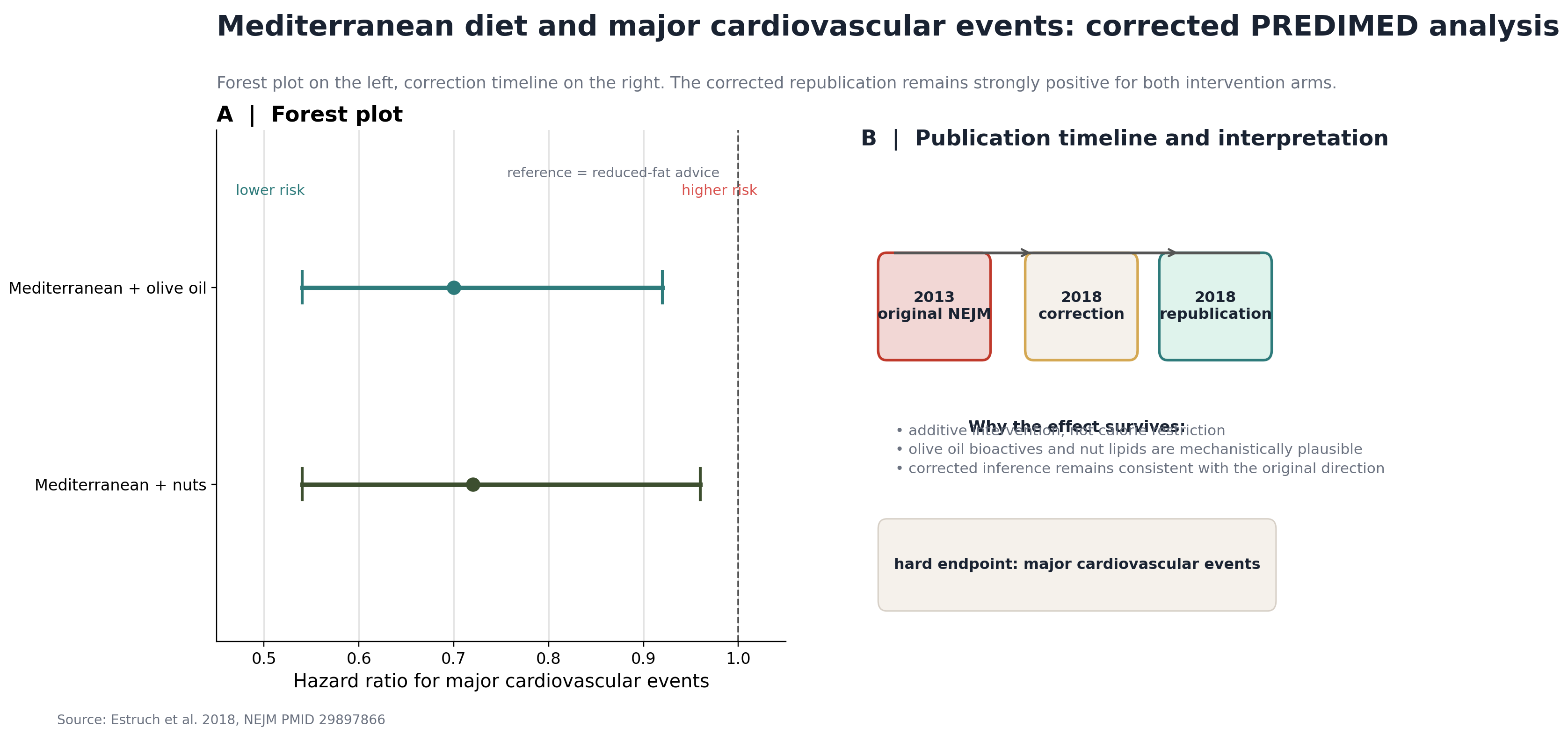
The corrected analysis preserved the main result: both Mediterranean diet arms reduced major cardiovascular events relative to reduced-fat advice, and the 2018 republication is the correct version to cite.
Forest plot with hazard ratios and confidence intervals for major cardiovascular events.
What Is the Mediterranean Diet?
The dietary pattern studied in PREDIMED emphasised:
- High intake: olive oil as the primary fat, vegetables, legumes, fruits, nuts, whole grains, fish
- Moderate intake: poultry, eggs, dairy
- Low intake: red meat, processed foods, refined carbohydrates, sugary drinks
The intervention was additive — participants were asked to add olive oil or nuts to their existing diet, not to follow a calorie-restricted regimen. This makes the finding particularly relevant to real-world dietary guidance.
Why Olive Oil?
Extra-virgin olive oil contains bioactive compounds beyond its well-known oleic acid (a monounsaturated fat):
- Oleocanthal: A phenolic compound that inhibits the same COX-1 and COX-2 enzymes targeted by ibuprofen. Beauchamp et al. (2005) in Nature showed that the throat irritation of high-quality olive oil is caused by oleocanthal's COX inhibition, and estimated its anti-inflammatory activity at roughly 10% of an ibuprofen dose per 50 mL of oil.
Citation: Beauchamp GK et al. (2005). Nature, 437:45–46. PMID: 16136122 - Hydroxytyrosol and oleuropein: Polyphenols with antioxidant properties, associated with resistance of LDL particles to oxidation.
Why Nuts?
Nuts provide a dense combination of monounsaturated and polyunsaturated fats, plant sterols (which compete with dietary cholesterol for intestinal absorption), magnesium, arginine (a nitric oxide precursor that promotes vasodilation), and polyphenols. The PREDIMED nuts arm used walnuts, almonds, and hazelnuts.
The Broader Evidence Base
PREDIMED is not an isolated finding. A 2010 meta-analysis by Sofi et al. pooled 12 prospective cohort studies (1.5 million participants) and found that each 2-point increase in Mediterranean diet adherence score was associated with:
- 9% reduction in cardiovascular mortality
- 6% reduction in cancer mortality
- 13% lower incidence of Parkinson's and Alzheimer's disease
Supporting citation: Sofi F, Cesari F, Abbate R, Gensini GF, Casini A. (2010). Adherence to Mediterranean diet and health status: meta-analysis. BMJ, 337:a1344.
PMID: 18786971
What PREDIMED Cannot Tell Us
PREDIMED was conducted in a Spanish population at high cardiovascular risk. Benefits may differ in populations with different baseline diets, different cardiovascular risk profiles, or different genetic backgrounds. The trial supplemented an existing diet — it does not test the Mediterranean diet against a controlled baseline diet from scratch. Individual responses to dietary fat also vary substantially based on genetics (e.g., APOE genotype).
All specific effect sizes cite primary peer-reviewed literature. PREDIMED results apply to adults at elevated cardiovascular risk; benefits in other populations are less well characterised. This content is for scientific information only and does not constitute medical advice. Consult a healthcare provider for personalised dietary guidance.
Need a structured report on Mediterranean diet evidence for a specific health outcome, ingredient class, or audience?
Request a Report