Turmeric has been used in South Asian cooking and Ayurvedic medicine for more than 4,000 years. The compound responsible for its yellow colour and most of its studied biological activity is curcumin — a polyphenol that accounts for roughly 2–5% of the dry weight of the turmeric root.
The challenge is that curcumin is notoriously difficult for the body to absorb. Taken alone, it is rapidly metabolised in the intestinal wall and liver, and serum concentrations after a standard oral dose typically remain very low — in some subjects, below the detection limit of standard assays.
The Piperine Effect
In 1998, researchers at St John's Medical College in Bangalore published a small but important human study in Planta Medica. They gave ten healthy volunteers 2 g of curcumin alone, and a separate group the same dose combined with 20 mg of piperine — the compound responsible for black pepper's bite.
When piperine was co-administered, measurable serum curcumin concentrations appeared in subjects where curcumin alone had been essentially undetectable. The area under the plasma concentration–time curve (AUC) increased substantially with piperine co-administration.
Primary citation: Shoba G, Joy D, Joseph T, Majeed M, Rajendran R, Srinivas PS. (1998). Influence of piperine on the pharmacokinetics of curcumin in animals and human volunteers. Planta Medica, 64(4):353–356.
PMID: 9619120
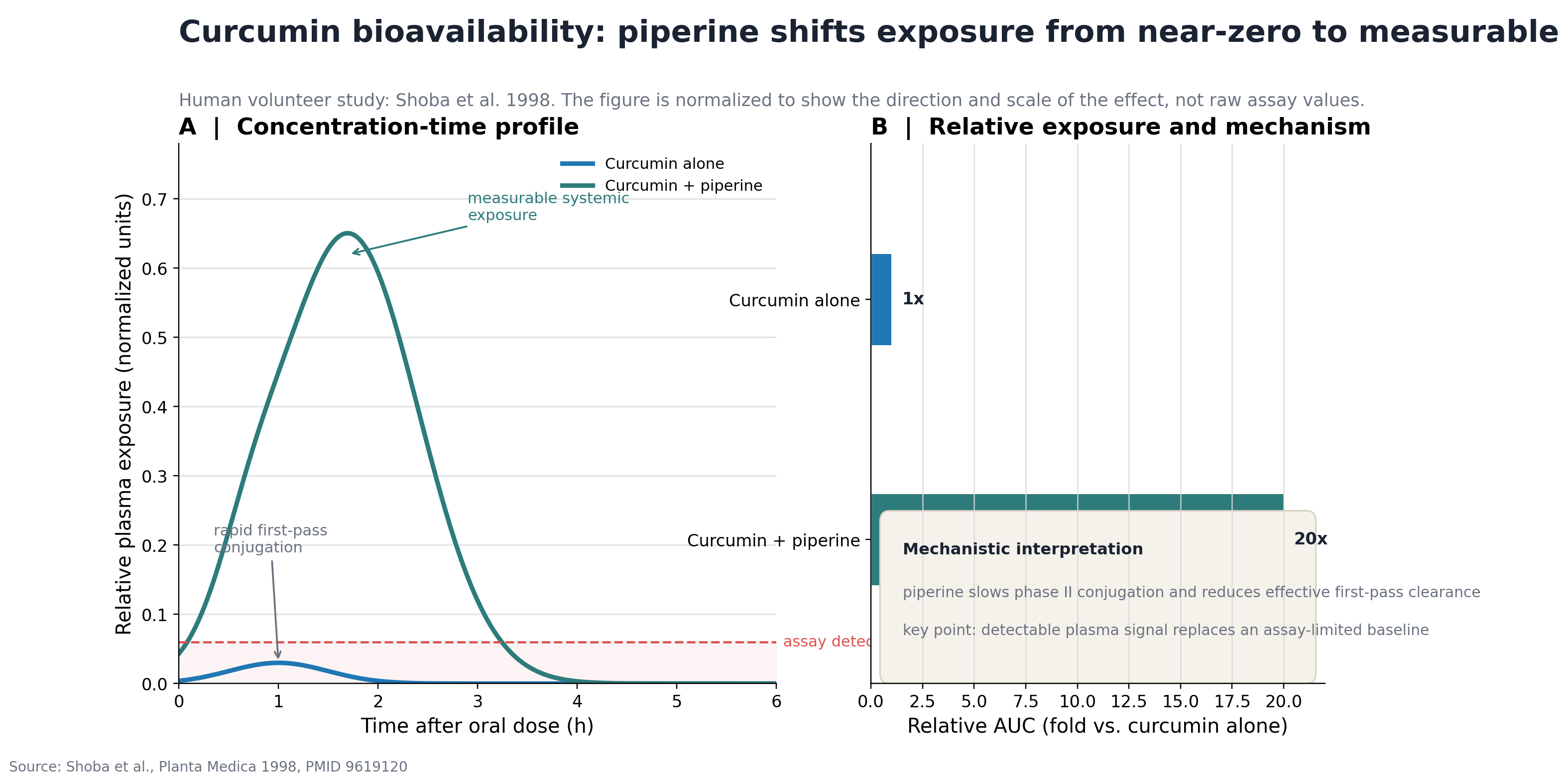
Curcumin alone remains close to an assay-limited baseline, whereas co-administration with piperine produces a measurable exposure curve and a much larger relative AUC.
Normalized illustration of the direction and scale of the effect reported by Shoba et al. 1998.
The often-cited figure of "2,000% increase in bioavailability" is derived from this study, but requires careful interpretation. Because serum curcumin was near zero or undetectable in many subjects in the control group, percentage calculations amplify dramatically. The clinically relevant finding is that piperine reliably shifts curcumin from undetectable to measurable in human plasma — a meaningful practical difference, even if the percentage figure overstates it.
How Piperine Works
Piperine acts through two complementary mechanisms:
- Phase II metabolism inhibition: The gut wall and liver rapidly conjugate curcumin through glucuronidation. Piperine slows this first-pass clearance, allowing more intact curcumin to remain available for absorption and circulation.
- Efflux modulation: Piperine may also reduce intestinal export of curcumin, which helps explain why the same oral dose produces a measurable plasma signal when piperine is present.
The practical point is not that piperine turns curcumin into a perfect drug. It changes the exposure curve enough that a molecule that is normally cleared quickly can be measured in human plasma.
What Research Shows About Curcumin Once Absorbed
With improved bioavailability established, curcumin has been studied extensively for:
- Anti-inflammatory activity: Curcumin inhibits NF-κB, a master transcription factor controlling inflammatory gene expression. This has been demonstrated in multiple cell-based studies and several human trials.
- Antioxidant capacity: Curcumin scavenges reactive oxygen species and upregulates endogenous antioxidant enzymes (superoxide dismutase, catalase, glutathione peroxidase).
- Metabolic effects: Some clinical trials have shown modest improvements in fasting blood glucose and lipid profiles with supplementation, though effect sizes vary considerably across studies.
The majority of curcumin research uses supplemental doses (500–8,000 mg/day) far above what is typically consumed from dietary turmeric (~100–500 mg curcumin/day in South Asian cuisine). Observed benefits in clinical trials should not be assumed from dietary spice consumption alone. Concentrated curcumin supplements may also interact with anticoagulants and certain chemotherapy agents.
Fat Co-consumption Also Helps
Curcumin is lipophilic — it dissolves in fat, not water. Consuming turmeric with dietary fat (as in most traditional curry preparations) aids micellar solubilisation and intestinal absorption, independently of the piperine effect. Traditional culinary preparations that combine turmeric with both fat and black pepper predate the research by millennia.
Practical Takeaway
- Turmeric combined with black pepper and a fat source maximises curcumin absorption from food
- For supplements, products that include piperine (bioperine) or use lipid-based delivery (phospholipid complexes, nanoemulsions) will achieve better serum concentrations
- Clinical evidence for specific health outcomes requires supplemental doses; the piperine co-administration finding does not change this threshold
All claims cite primary peer-reviewed literature. Curcumin or piperine supplementation may interact with medications. Consult a healthcare provider before supplementing. This content is for scientific information only and does not constitute medical advice.
Need a deeper analysis of curcumin bioavailability, delivery formats, or clinical evidence for a specific outcome?
Request a Report