When most people think of coffee's bioactive compounds, caffeine comes first. But a class of polyphenols called chlorogenic acids (CGAs) may be at least as important for metabolic health — and they work entirely independently of caffeine.
What Are Chlorogenic Acids?
Chlorogenic acids are esters of caffeic acid and quinic acid. The most abundant is 5-caffeoylquinic acid (5-CQA), which accounts for the majority of total CGA content in coffee.
| Brewing method | Chlorogenic acids (per cup) |
|---|---|
| Filtered drip coffee (200 mL) | 280–350 mg |
| Espresso (30 mL) | 80–150 mg |
| Dark roast (any method) | ~10–20% of light roast content |
CGAs are also found in tea, apples, blueberries, artichokes, and potatoes — but coffee is the dominant dietary source in most Western populations simply because of consumption volume.
The Decaffeinated Coffee Evidence
The most compelling evidence that CGAs drive coffee's metabolic benefits — not caffeine — comes from studies comparing regular and decaffeinated coffee.
A 2014 dose-response meta-analysis by Jiang et al. pooled 26 prospective studies and found that both caffeinated and decaffeinated coffee tracked with lower type 2 diabetes incidence:
| Coffee type | Type 2 diabetes risk per additional cup/day |
|---|---|
| Caffeinated coffee | −9% (RR 0.91, 95% CI 0.89–0.94) |
| Decaffeinated coffee | −6% (RR 0.94, 95% CI 0.91–0.97) |
The key finding is that decaffeinated coffee still tracks with lower type 2 diabetes incidence. That preserves a non-caffeine mechanistic explanation, with chlorogenic acids the most plausible candidate.
Primary citation: Jiang X, Zhang D, Jiang W. (2014). Coffee and caffeine intake and incidence of type 2 diabetes mellitus: a meta-analysis of prospective studies. European Journal of Nutrition, 53(1):25–38.
PMID: 24150256
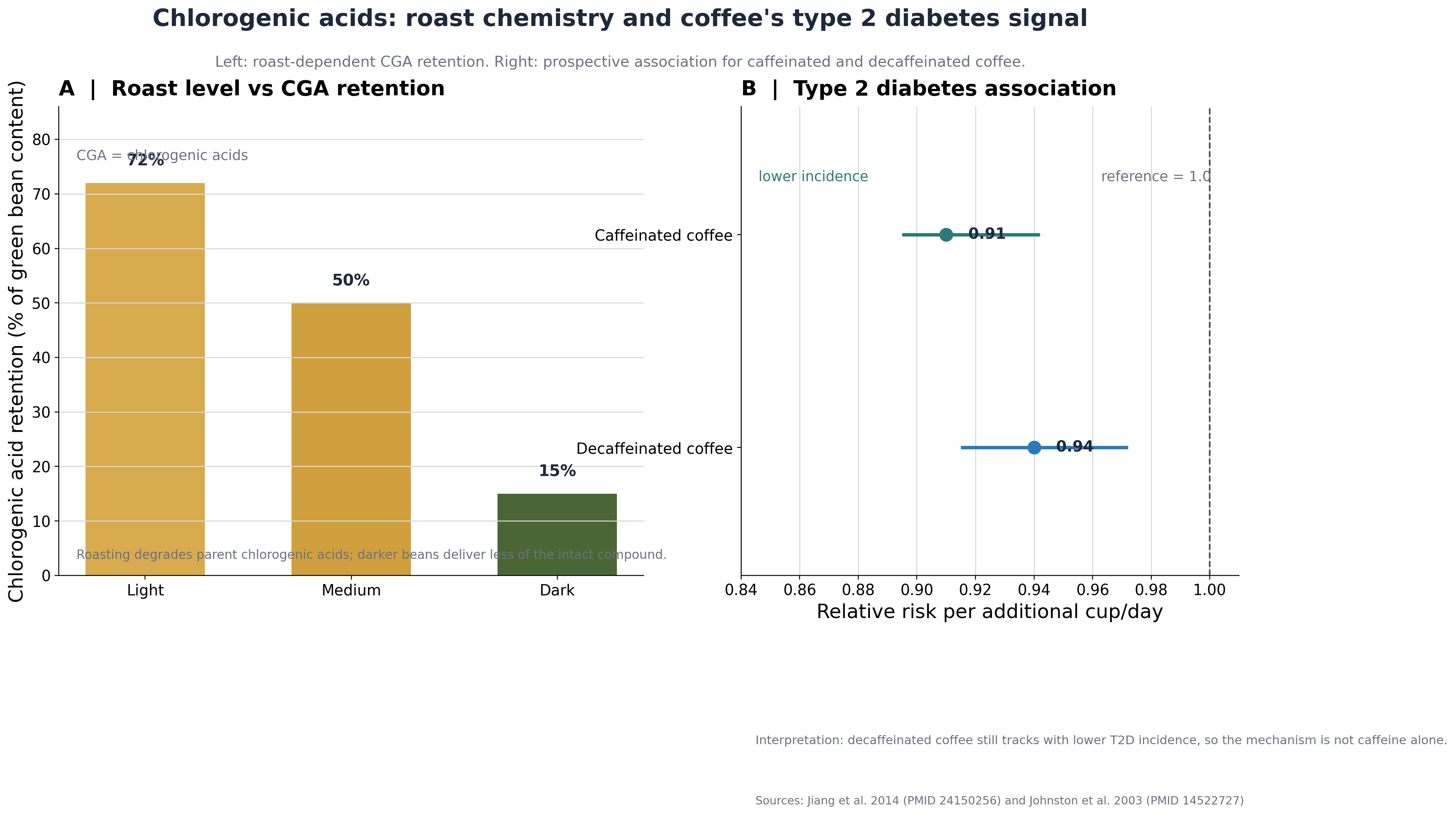
Roasting reduces chlorogenic acid content, while both caffeinated and decaffeinated coffee still track with lower type 2 diabetes incidence. That pairing is why the non-caffeine chemistry matters mechanistically.
Left: roast chemistry. Right: prospective association per additional cup/day.
How Chlorogenic Acids Affect Glucose Metabolism
1. Slowing glucose absorption
CGAs inhibit intestinal glucose transporters (SGLT1 and GLUT2), reducing the rate at which glucose crosses the gut wall into circulation. This blunts the post-meal blood glucose peak.
A human trial by Johnston et al. (2003) tested this directly: participants received either water, caffeinated coffee, decaffeinated coffee, or a matched CGA extract before a glucose challenge. Both decaffeinated coffee and the pure CGA extract significantly reduced the incremental blood glucose response compared to water. Caffeine alone did not produce this effect.
Supporting citation: Johnston KL, Clifford MN, Morgan LM. (2003). Coffee acutely modifies gastrointestinal hormone secretion and glucose tolerance in humans: glycemic effects of chlorogenic acid and caffeine. American Journal of Clinical Nutrition, 78(4):728–733.
PMID: 14522727
2. AMPK activation
In cell and animal studies, CGAs activate AMP-activated protein kinase (AMPK) — the same cellular energy sensor targeted by metformin. Activated AMPK promotes glucose uptake into muscle cells, reduces hepatic glucose output, and improves insulin sensitivity.
The AMPK activation pathway is primarily established in cell-based and animal models. Direct human clinical evidence for this specific mechanism is limited. The epidemiological association and the glucose-absorption blunting effect (Johnston 2003) are better supported in humans than the AMPK pathway specifically.
3. Antioxidant activity
CGAs are potent antioxidants that reduce oxidative stress — a contributing factor to both insulin resistance and endothelial dysfunction. Coffee is the largest contributor to total antioxidant intake in the Western diet by volume of consumption (not because it is the richest source per gram, but because people drink a lot of it).
What Roasting Does to Chlorogenic Acids
CGAs are heat-sensitive and degrade substantially with roasting:
| Roast level | CGA retention (approx.) |
|---|---|
| Light roast | 60–80% of green bean content |
| Medium roast | 40–60% |
| Dark roast | 10–20% |
Lactones of chlorogenic acids form during roasting and retain some biological activity, but the parent CGAs are substantially degraded. For maximum polyphenol intake, lighter roasts deliver significantly more CGAs per cup.
Practical Considerations
- Filtered drip coffee (light to medium roast) delivers the most CGAs per cup
- Decaffeinated coffee — especially processes that preserve most polyphenols while removing most caffeine — is a valid alternative for those sensitive to caffeine
- The glucose-absorption-slowing effect appears most relevant when coffee is consumed with or shortly before a carbohydrate-containing meal
- CGAs are also present in apples, artichokes, and blueberries; dietary variety in polyphenol sources matters
All risk reduction figures are from observational meta-analyses. Observational studies demonstrate association, not causation. Chlorogenic acid supplementation is not approved to treat or prevent any disease. This content is for scientific information only and does not constitute medical advice.
Need a deeper evidence report on chlorogenic acids, coffee polyphenols, or insulin sensitivity evidence for a specific audience?
Request a Report